
Stop making AI about productivity. Make it about happiness.
The organisations getting the best results from AI aren't chasing efficiency metrics. They're letting employees fix the things that annoy them — and the numbers follow. Here's why happiness, not productivity, is the metric that actually moves the needle, and what to do about it on Monday morning.
You're solving the wrong problem
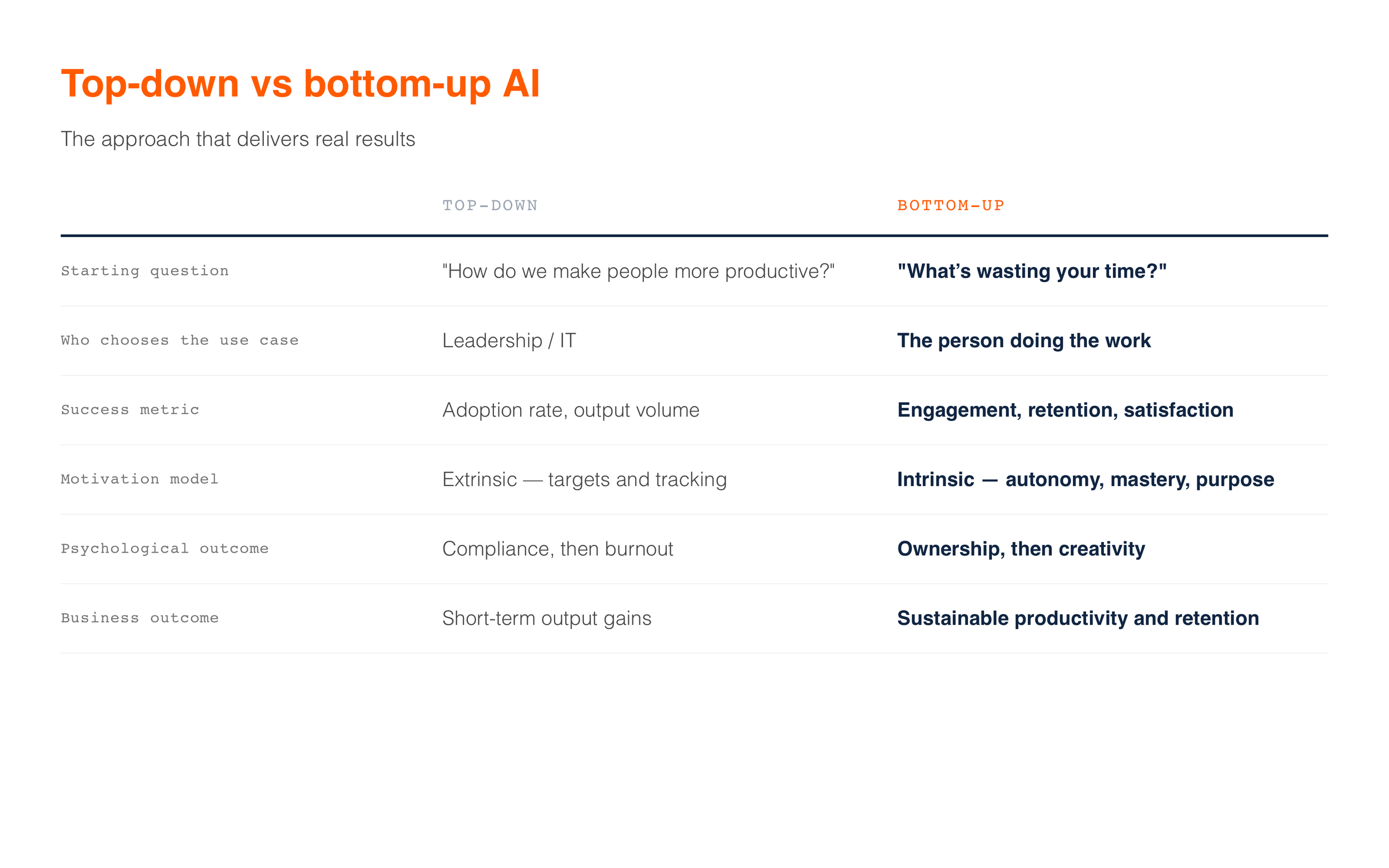
There's a question that kicks off almost every AI rollout: "How do we make our people more productive?" It sounds reasonable. It isn't. When you start there, you end up buying tools, setting adoption targets, measuring output — and then wondering why your most productive AI users are burning out and your engagement scores are dropping.
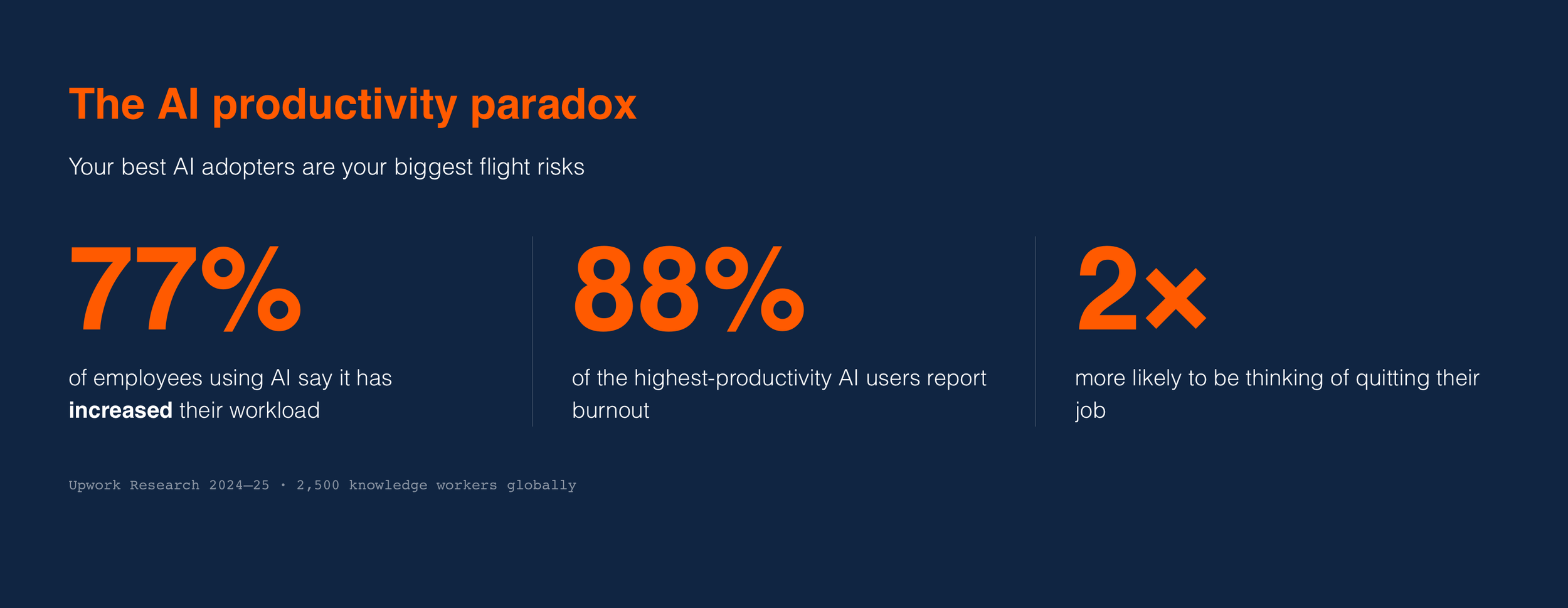
Upwork surveyed 2,500 workers globally and found that 77% of employees using AI say it has actually increased their workload. Their 2025 follow-up made it worse: among those reporting the highest productivity gains from AI, 88% were also experiencing burnout, and they were twice as likely to be thinking about quitting. Read that again — your best AI adopters are your biggest flight risks.
Most rollouts follow a familiar script. Leadership picks a tool, IT configures it, comms sends a "getting started" email, and someone tracks adoption percentages in a spreadsheet. Six months later a few power users are doing interesting things, and everyone else has either ignored it or is using it to generate emails they then rewrite anyway. What nobody asked was the only question that matters: what do your people actually want AI to do?
What people actually want from AI
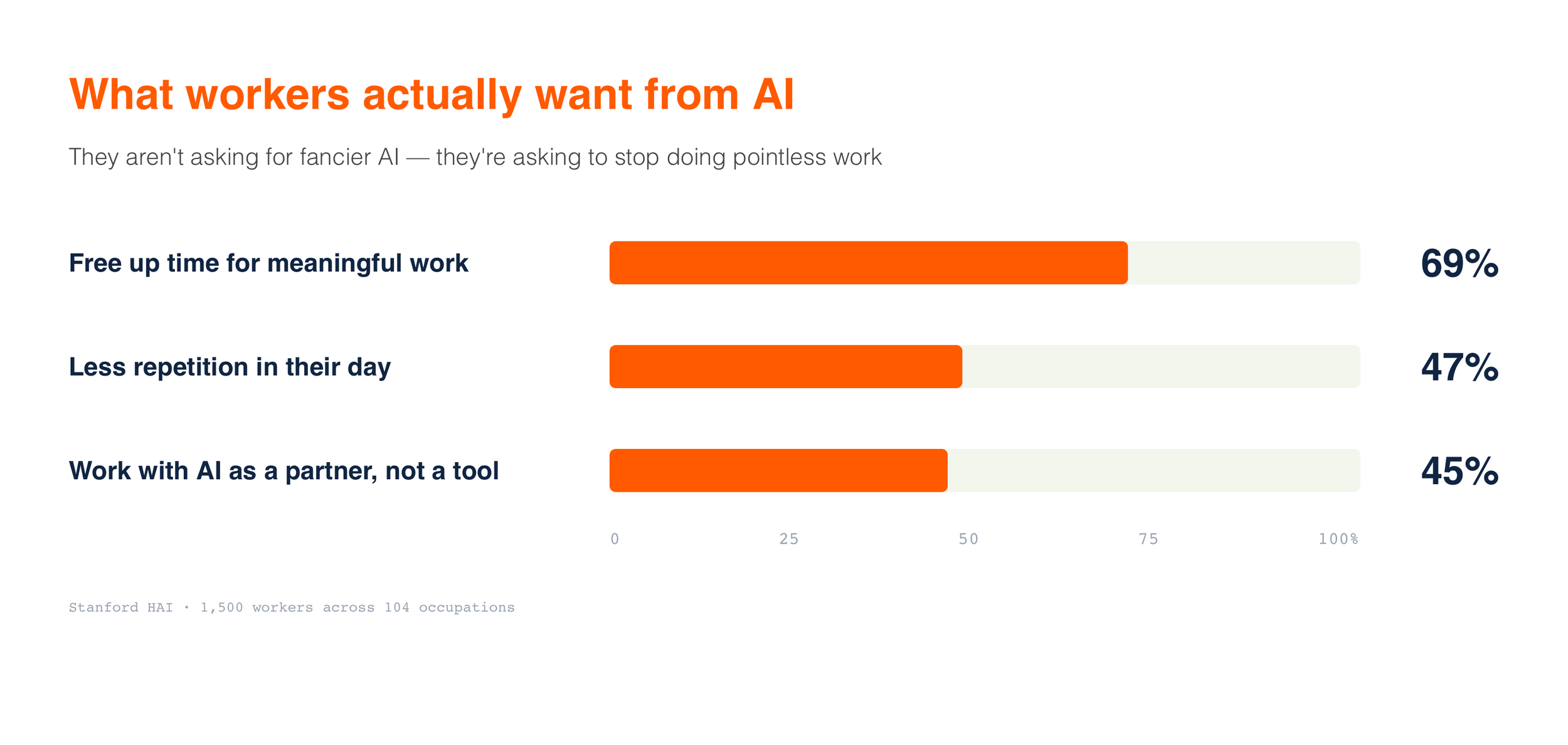
Stanford HAI asked. They surveyed 1,500 workers across 104 occupations, and the answer was boringly obvious: people want AI to take away the repetitive tasks they never wanted to do in the first place.
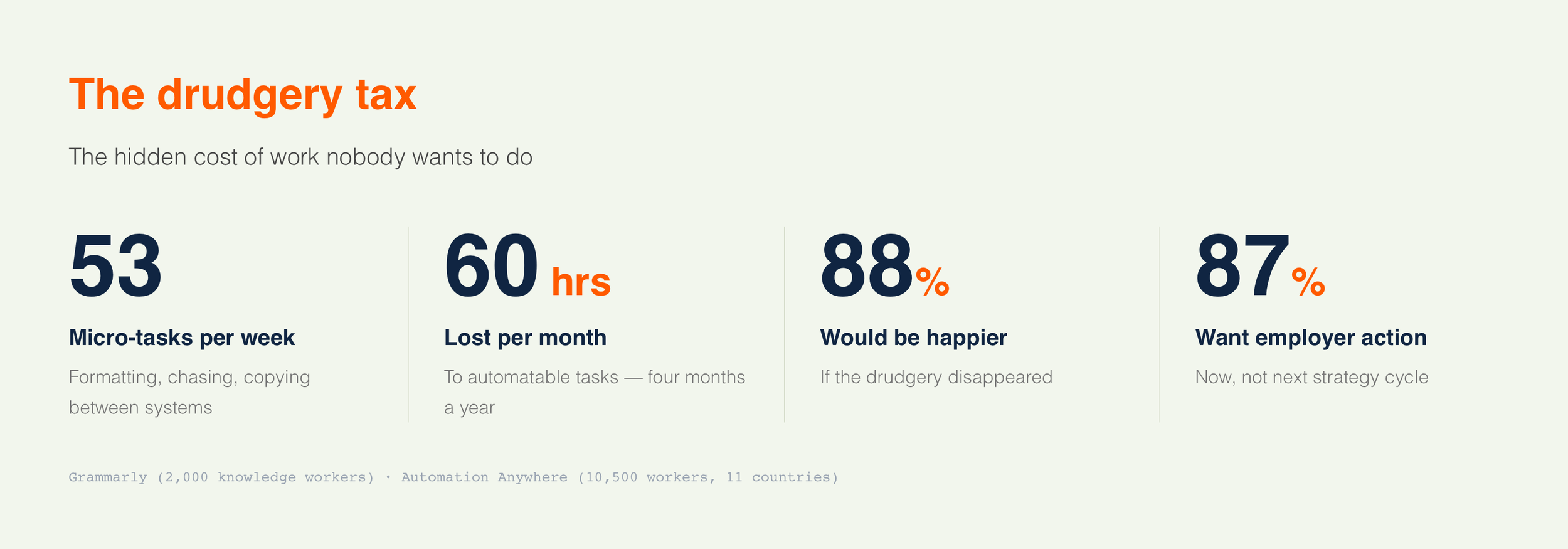
A Grammarly study of 2,000 knowledge workers put a number on it. The average person deals with 53 momentum-killing micro-tasks every week — formatting reports, chasing approvals, copying data between systems — costing them three and a half hours of genuinely productive time. More than half said they'd consider leaving a job where the admin burden got too heavy.
Automation Anywhere went bigger, surveying 10,500 workers across 11 countries. They found employees lose roughly 60 hours a month to tasks they know could be automated. That's over four months of working time a year, spent on the things that make people miserable.
Happy people are productive people
This is where it gets interesting, because the causal direction isn't what most leaders assume. The standard thinking goes: give people better tools, they produce more, they feel good about it. The research says it works the other way round.
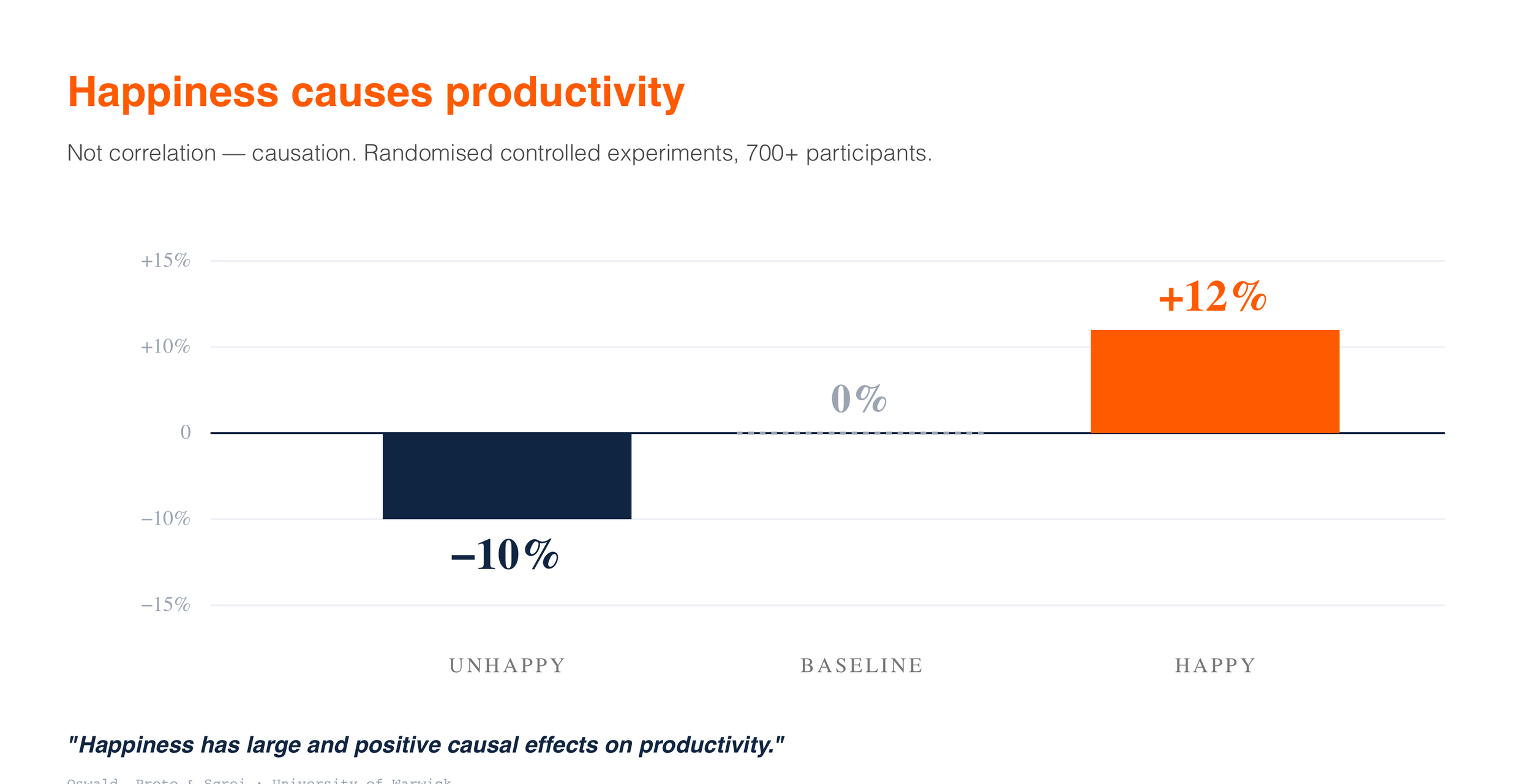
The University of Warwick ran four controlled experiments with over 700 participants. They made some people happier — comedy clips, snacks, low-tech stuff — and measured the impact on output. Happiness didn't correlate with productivity; it caused it.
Oxford's Saïd Business School saw the same thing in the real world, working with BT's telesales teams. Happy workers didn't work longer hours — they converted more calls into sales. Same time at their desk, better results.
Gallup's meta-analysis — 3.3 million employees across 347 organisations — found that top-quartile engaged teams deliver dramatically better outcomes: 23% higher profitability and 51% lower turnover. The single biggest factor explaining the variance? Their manager.
Harvard's Study of Adult Development has been running since 1938 — 88 years and counting. The finding that keeps coming back is that the quality of your relationships predicts your happiness, your health and your cognitive performance better than your income, your job title or your IQ.
Let people own the fix
There's a framework in motivational psychology called Self-Determination Theory that maps this out precisely. It says humans need three things to thrive: autonomy, competence and relatedness. Decades of research confirm it.
Now think about what happens when you say to someone: "What's the most annoying part of your week? Here's an AI tool. Go fix it. Show the team what you built." One question, and you've hit all three needs at once.
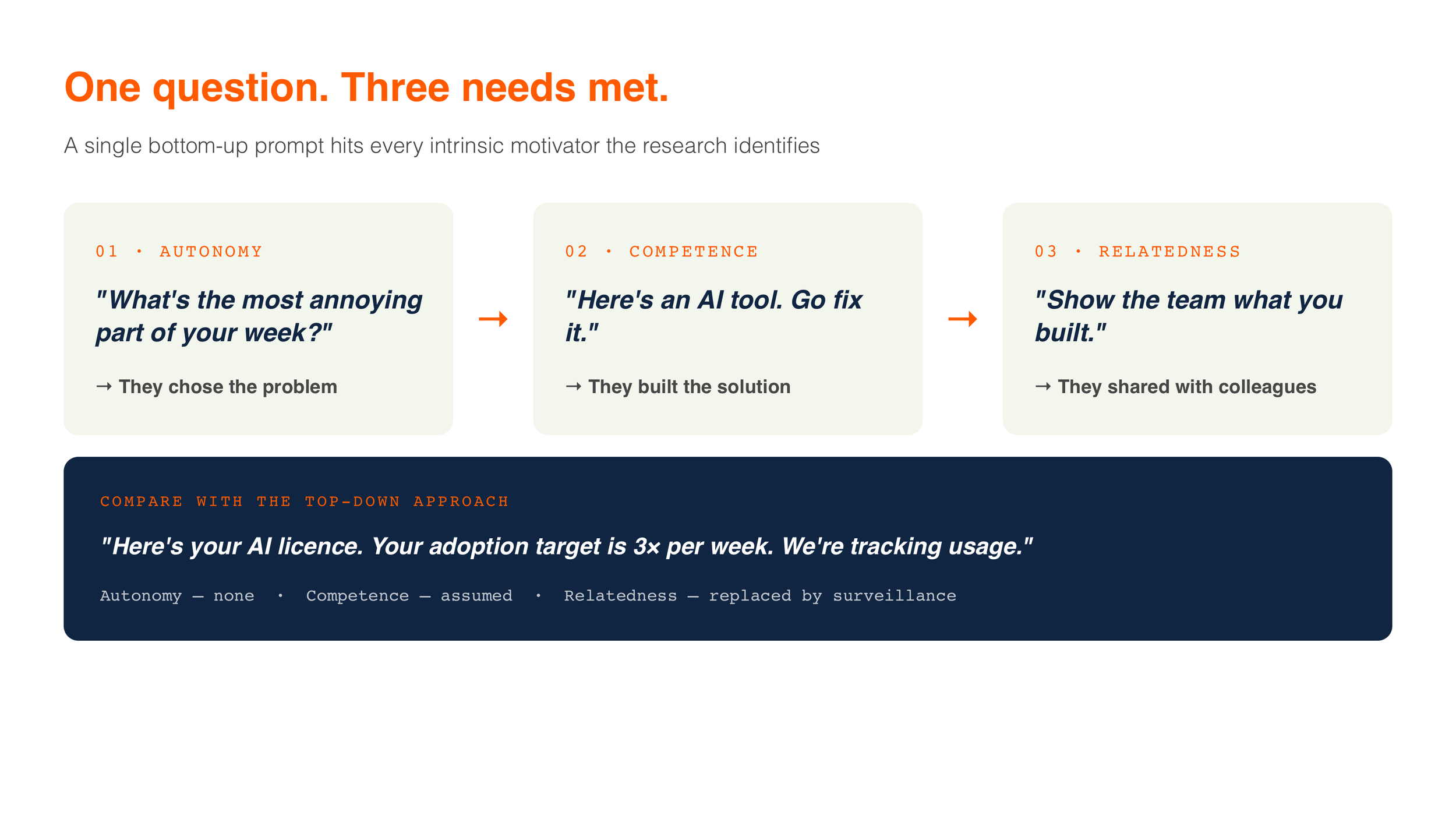
The University of Birmingham studied 20,000 employees and found that higher autonomy predicted better wellbeing and higher job satisfaction, regardless of the type of work. The people who get the most value from AI are the ones who found their own use case — not the ones who were told to use it.
The retention maths
This isn't just a wellbeing argument — the economics are straightforward. Gallup puts the cost of disengagement at up to 18% of each affected employee's salary, and replacing someone who leaves costs between half and double their annual pay.
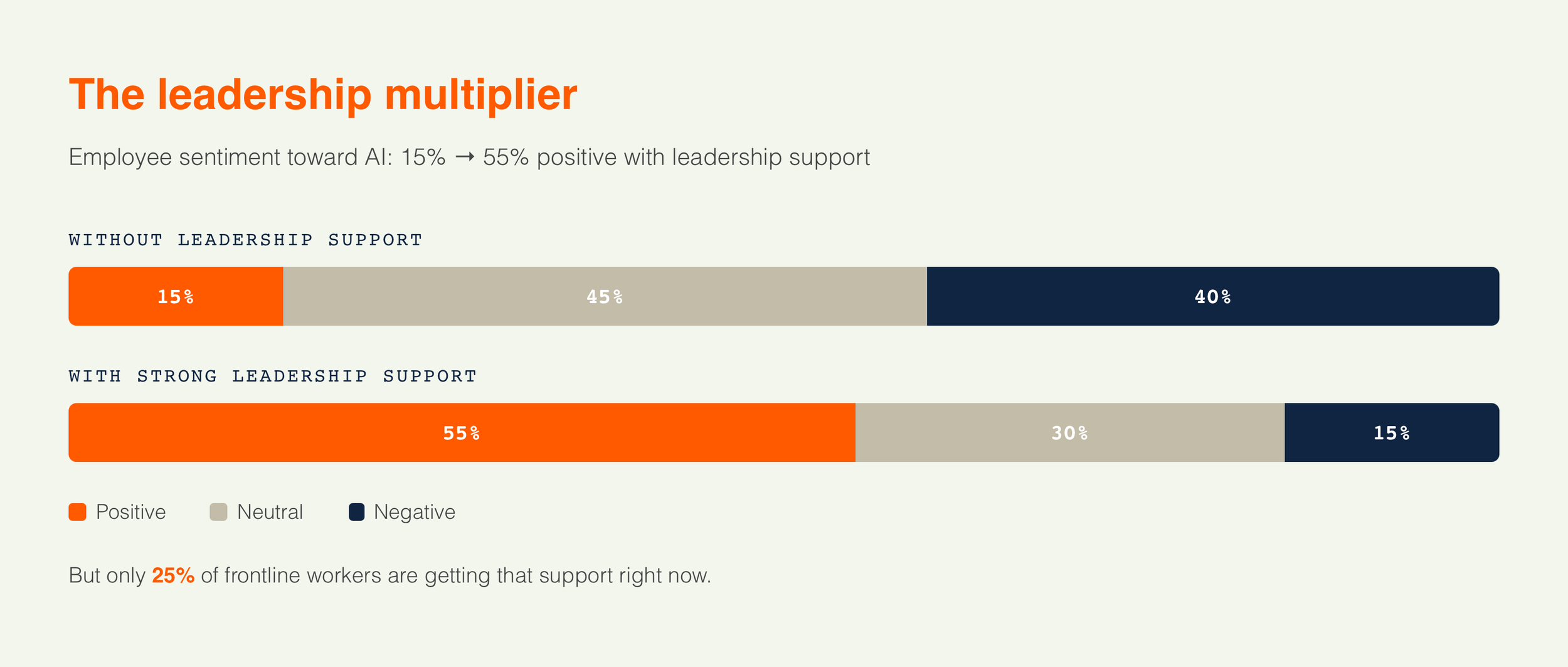
BCG's numbers are striking: employee sentiment toward AI jumps dramatically when leadership actively supports the rollout. But only a quarter of frontline workers are getting that support right now.
Slack's Workforce Lab found that employees who've been properly trained on AI are 19 times more likely to say it helps their productivity, and report 81% higher job satisfaction. BCG's research found that five or more hours of training turns 79% of employees into regular AI users. PwC's survey of 50,000 workers across 48 countries confirmed the pattern: supported learners are dramatically more motivated.
When people have agency over how AI enters their work, they stick around.
What to actually do
Forget the 12-month AI transformation roadmap. Try this instead.
Not in an all-hands. In small groups, or anonymously. Find out which tasks make them want to put their head through their monitor.
A few hours a month. An AI tool. Maybe a Slack channel where people share what they've built. This doesn't need a programme name or a steering committee.
When someone automates the weekly report that used to take two hours, let them present it at the team meeting. Name it after them if you want.
BCG found that five or more hours of AI training turns 79% of employees into regular users. But it has to be practical, and tied to their actual workflow.
Track engagement and retention alongside output. If productivity goes up but your best people are leaving, you've optimised yourself into a hole.
The uncomfortable bit
Most AI strategies are designed around what leadership wants — efficiency, cost reduction, competitive positioning — rather than what employees want: less drudgery, more meaning, some control over their working day. The research says that's backwards. Not as a fluffy HR argument, but as a hard commercial one.
AI gives us the best tool we've ever had for eliminating the repetitive, low-value work that grinds people down. But only if you let the people doing the work decide what gets automated.
Cloudscaler works with regulated organisations to deploy AI that works for their people, not just their processes. Our Enterprise AI Fast Start begins with your workforce — finding the drudgery worth automating, building the first wave of use cases with the people who do the work, and putting the governance in place so you can scale safely. If you want an AI strategy that starts with your people, we should talk.